


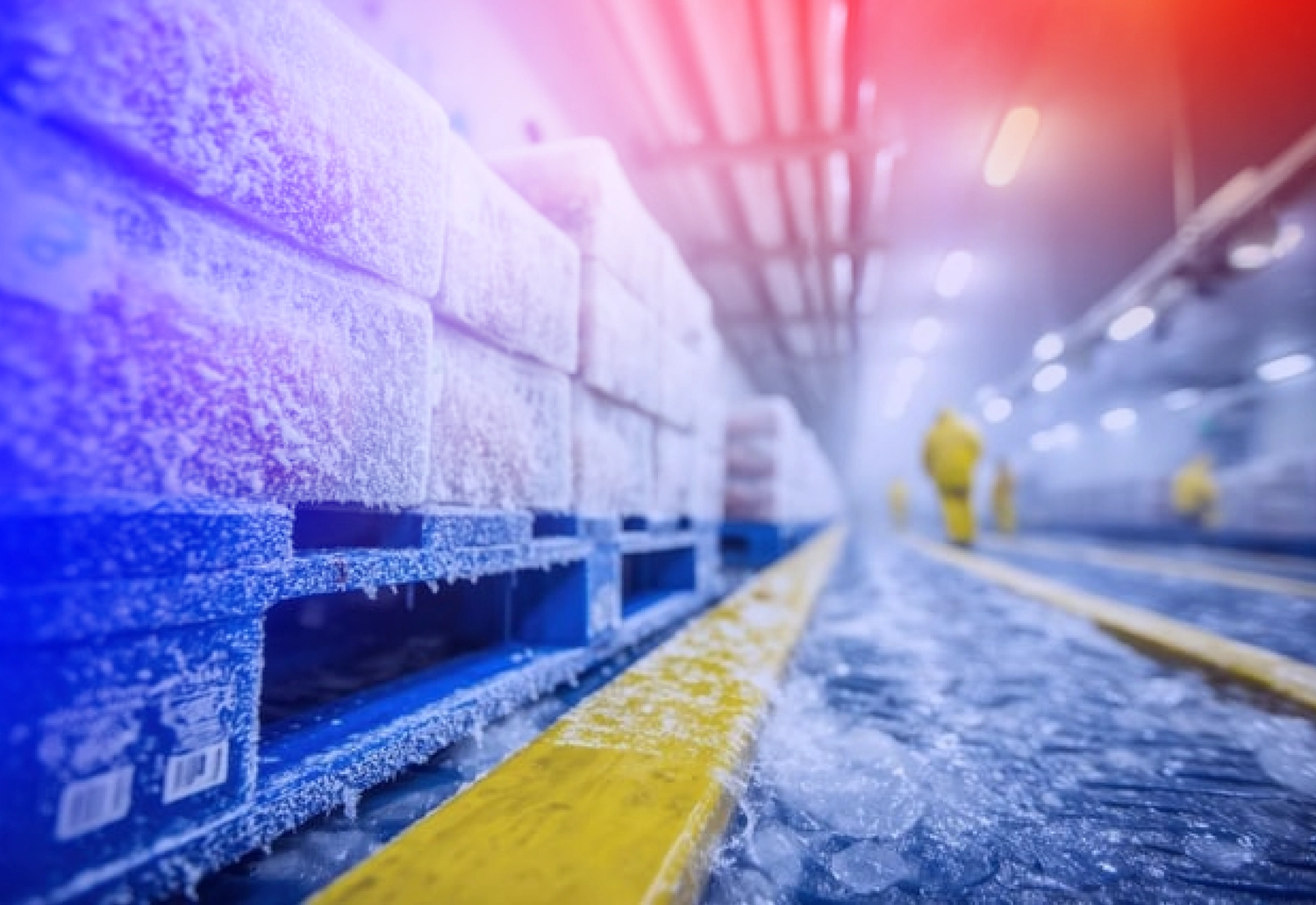
Driving cold-chain efficiencies that combat food waste is on-brand for grocery retailers.
“We care deeply about feeding families, not landfills,” says Mike Roberts, VP of produce operations at Springdale, Ark.-based independent regional grocery chain Harps Food Stores.
That’s why Harps and other retailers are partnering with industry suppliers on solutions that reduce shrink, improve product consistency, streamline product fulfillment and maintain regulatory compliance.
With the continued expansion and household acceptance of online grocery, the cold chain plays an increasingly critical role in maintaining food safety and shopper trust. Innovations in temperature technology, sensors, packaging, back-of-house layouts and predictive maintenance are all becoming key differentiators for grocery operators.
All of the Variables
In a move toward enhancing its brand promise, Harps is moving forward with its adoption of HarvestHold Fresh, a post-harvest solution from Centennial, Colo.-based ag tech company Verdant Technologies. Fully embracing the solution follows a successful pilot with Castroville, Calif.-based grower partner Ocean Mist Farms that delivered measurable gains in broccoli quality across the iceless broccoli supply chain.
“We saw better-looking broccoli and higher sell-through in stores,” Roberts notes. “This is exactly the kind of innovation we look for.”
Verdant is working with retailers and growers more often to shore up the cold chain. “We do a lot of education with growers and retailers to point to the root cause of quality issues,” says Matthew Aronson, Verdant’s chief revenue officer. “All of the work we’ve done to gather data and assess operations in terms of cooling methods and effectiveness ... gives us a unique vantage point.”
The ability of retailers to effectively manage their cold chain depends on a host of factors, Aronson explains: “Who’s responsible for trucking, how far are the trucks moving, what time of year is it, how many distribution centers are being managed, how many suppliers are they sourcing from.”
With higher prices at the grocery store and online fulfillment on the rise, consumer expectations are increasing accordingly, Aronson notes. “The demand for fresh, combined with third-party shopping, makes consistency increasingly important. Delivering that consistency can be a challenge,” he says. “Finding ways to ensure consistency and freshness has never been more important, and relying on legacy systems may not be enough.”
Real-Time Visibility
According to Giampaolo Marino, chief strategy and growth officer at San Jose, Calif.-based wireless power solution provider Energous, the biggest challenge is visibility.
“Grocery retailers are managing highly perishable products across complex environments, from distribution centers to store shelves to last-mile delivery, but much of the cold chain is still monitored through point-in-time checks rather than continuous data,” Marino says. “Teams are forced into reactive decision-making instead of preventing issues in the moment.”
Marino calls Energous’ ambient IoT (Internet of Things) a “more continuous, proactive approach” to cold-chain monitoring. “Our technology supports battery-free sensing that continuously monitors temperature across critical points in the cold chain,” he explains. “That continuous visibility is what turns monitoring into action.”
Teams can intervene earlier by correcting storage conditions, moving product faster, or isolating at-risk inventory before quality or safety is compromised, Marino says. “At the center of this is our e-Sense sensor tag, combined with PowerBridge transmitters and the e-Compass cloud platform. It harvests energy over the air from PowerBridge transmitters, eliminating the need for batteries or wired infrastructure.”
Wiliot, a supply chain intelligence platform based in Israel with U.S. offices in Arkansas, California, New York and Texas, also offers an ambient IoT system.
“IoT Pixels continuously capture data on location, movement and environmental conditions. That data flows into Wiliot’s Physical AI platform, where it is aggregated, contextualized and analyzed to create a live, item-level view of inventory across the entire network,” explains Wiliot VP Amir Khoshniyati. “Through a centralized dashboard, retailers can monitor product flow, freshness conditions, dwell time and handling events in near real time.”
Being Proactive
Energy costs are putting pressure on the cold chain, says Tatiana Muñoz, director of U.S. sales and business development for New York-based Hardis Supply Chain. “When global events push oil or natural gas prices higher, the cost of operating temperature-controlled facilities and transportation rises quickly,” Muñoz asserts.
Additionally, regulatory expectations around traceability and food safety continue to increase, requiring precise records of product conditions and movements throughout the supply chain. “That requires strong operational discipline and systems that provide real-time visibility,” she says.
Muñoz advises retailers to treat cold-chain operations as a connected process rather than a series of isolated steps. “By integrating warehouse, transportation and inventory data, they can make faster decisions, protect product quality and adapt more effectively when supply conditions change,” she notes.
Hardis’ cloud-based appointment-scheduling solution is designed to fully digitize carrier slot booking at distribution centers. “Retailers gain a shared view of inbound and outbound activity, along with tools for capacity management, document sharing and performance tracking,” Muñoz says.
Australian supply chain consultant TMX Transform uses simulation modeling to test scenarios before capital is deployed, explains Nick de Klerk, TMX’s Boston-based senior director.
We also focus heavily on execution, including multi-temperature facility design, yard operations and last-mile delivery, where many cold-chain failures actually occur.
According to de Klerk, the biggest opportunity to reduce shrink isn’t in the store – it’s upstream in the network. “It’s really about managing time and temperature across the entire journey, not just reacting to spoilage at the end,” he points out.
Erin Mitchell, COO of yard operations provider YMX Logistics, with headquarters in Henderson, Nev., and Kenosha, Wis., says that yard operations are a part of the cold chain that often receives less attention.
“A trailer sits longer than planned. A move is missed during a shift change. A plug-in is not checked. Each event may seem minor, but in temperature-sensitive environments, those minutes matter,” Mitchell observes. Delays can lead to temperature exposure, missed store deliveries, detention charges or compliance problems.
Some retailers and food shippers are adopting yard operating systems to align operations and technology into one integrated operating model, Mitchell explains. “This level of structure reduces variability at the point where product is most exposed,” she says. “Standardizing yard procedures gives leadership better visibility into what is happening at each location. It also makes it easier to identify problems early, before they affect product quality or store service.”
Staying Cool
What advice do suppliers have for retailers looking to up their cold-chain game?
“Don’t lose sight of the importance of maintaining the cold chain from their DCs to their stores,” Verdant’s Aronson says. “Come at it in a collaborative way. Stay curious and invite new solutions.”
Hardis’ Muñoz recommends taking “a holistic view of the cold chain” and “investing in systems that provide real-time visibility into inventory, product traceability and environmental conditions.”
Energous’ Marino advises, “The most important step is catching temperature deviations early enough to act.”
This article was originally published in Progressive Grocer on 15 April 2026.